



Dime mi sinyor padre
Description
This is one of the rarest songs in the repertoire, for which it has not yet been possible to verify information or identify it in any other source.
The language of the song is clearly Ladino; however, it is filled with Turkish words or words derived from Turkish.
It describes a dialogue between a father and his son, in which the latter asks his father for permission to marry, as he is already of appropriate age. The father responds cynically, essentially telling him the equivalent of the expression “you have nothing to your name.”
The song reflects the traditional mindset of the time, when marriage was a social institution closely tied to financial status and outward appearance. It also highlights the importance of dowry and a young man’s standing within the community.
Version 1
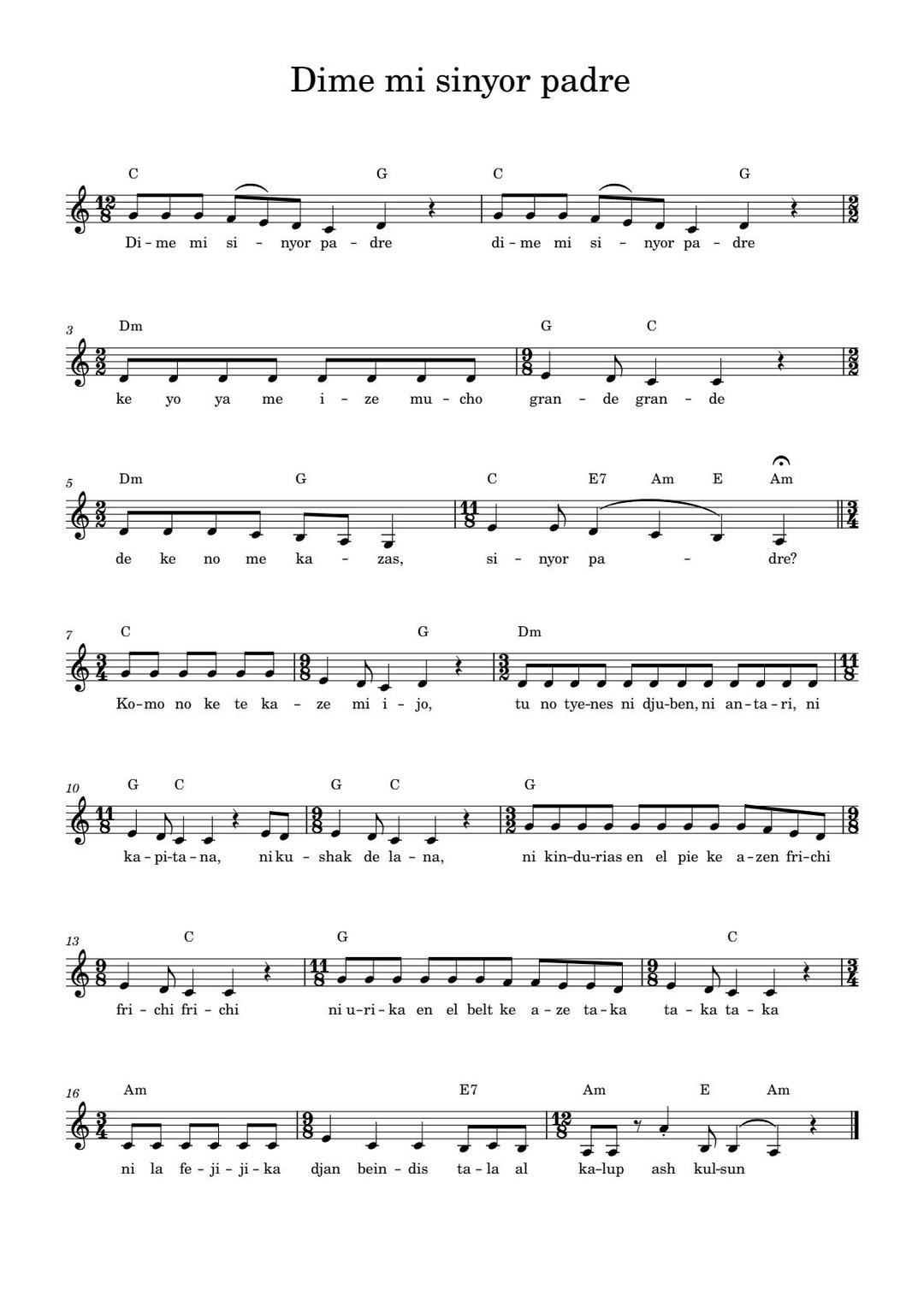
Dime mi sinyor padre
Archive of Flora Molcho. Performed by her father, Isaac Molcho.
Lyrics
Dime, mi sinyor padre, /ˈdime mi siˈɲoɾ ˈpaðɾe/ Tell me, my father,
ke yo ya me ize mucho grande, grande /ke ʝo ʝa me ˈize ˈmutʃo ˈɣɾande ˈɣɾande/ I am already quite grown, grown,
de ke no me kazas, sinyor padre? /de ke no me ˈkazas siˈɲoɾ ˈpaðɾe/ why don’t you marry me off, my father?
Komo no ke te kaze, mi ijo, /ˈkomo no ke te ˈkaze mi ˈiʒo/ How can I marry you off, my son,
tu no tienes, ni djuben, ni antari, ni kapitana, /tu no ˈtjenes ni dʒuˈben ni anˈtaɾi ni kapiˈtana/ you have neither robe, nor tunic, nor coat,
ni kushak de lana, ni stivaletos en el pie ke azen frichi frichi frichi, /ni kuˈʃak de ˈlana ni stivaˈletos en el pje ke ˈazen ˈfɾitʃi ˈfɾitʃi ˈfɾitʃi/ nor a woolen sash, nor boots on your feet that go “frichi, frichi, frichi,”
ni urika en el belt ke aze taka taka taka, /ni uˈɾika en el belt ke ˈaze ˈtaka ˈtaka ˈtaka/ nor a watch on your belt that goes “taka, taka, taka,”
ni la fejijika! /ni la feʒiˈʒika/ nor even the elegant little fez!
**Djan [1] beindis [2] dala al kalup[3] ash kulsun. [5] ** /dʒan beˈindis daˈla al kaˈlup aʃ kulˈsun/ May you find your fortune/may you settle properly in life.
[1] Can [dʒan] in Turkish means “soul.” Anyone who grew up in a household of Asia Minor refugees may remember the expression [dʒaˈnɯm] (canım), which was used to address a beloved person and means “my soul” or “my dear.”
[2] It is possible that the word derives from the verb bendezir (“to bless”), and within the context of the song it could mean “my blessed soul.” However, it may also derive from the Turkish verb beğenmek, which means “to approve.”
[3] Mold
[4] Idiomatic expression: “to fit into the mold,” or, as we would say today, “to find your way in life.”
Music Guide

 Bibliography
Nehama, Joseph. Dictionnaire du Judéo-Espagnol. Madrid: Consejo superior de investigaciones cientificas, 1977.
Research, analysis, translations and IPA transcriptions: Mariangela Chatzistamatiou Aural transcriptions and lead sheets: Nikos Panagiotides
Disclaimer: The content on this website is protected by copyright. Use of the content is allowed for personal or educational purposes only with clear citation of the source. Republishing, modifying, or using the content for commercial purposes is prohibited without prior explicit permission.

