





El komer de la manyana
Alternative Title: La madre komprensiva, La komida la manyana, La kumida la manyana
Description
This is a Sephardic song, particularly popular in the Turkish tradition, from which most of its known recordings originate. Isaac Molcho performs a unique version of the lyrics, one that does not appear in any other source and presents significant challenges for precise translation.
The melody of this song resembles that of Giorgos Mitsakis’ (1921–1993) song “To Diko Mou Paploma” (“My Own Quilt”) made popular by Greek singer Stelios Kazantzidis in 1965. It is not known which version came first, whether it was an original composition by Mitsakis or whether he was inspired by hearing an existing version of the well-known song. Most likely, the melody already existed as a traditional tune, and Mitsakis heard and incorporated it, rather than the reverse.
Since the song belongs to the established core of the Sephardic repertoire, we also present a conventional version of the lyrics. Each performer may choose which version to interpret. Ιn its conventional form, the song reflects aspects of traditional daily life, romantic behavior, and the relationship of women with family and the institution of marriage. It tells the story of a young girl who, with determination and by refusing to eat her breakfast, tries to persuade her mother to allow her to marry.
Version 1
El komer de la manyana
Archive of Flora Molcho Archive. Performed by her father, Isaac Molcho. This is a version that does not appear in any other known source. Its melody differs entirely from the widely known variants that have been preserved, while the text also shows significant deviations from the established versions, often lacking clear coherence in many parts. Research toward its accurate interpretation is ongoing.
Alternative Title: La madre komprensiva, La komida la manyana, La kumida la manyana
Lyrics
De esto i no vyenes aremata esta frankedad, /de ˈesto i no ˈvjenes aɾ:ɾeˈmata ˈesta fɾaŋkeˈðad/ If you do not come because of this, put an end to this frankness,
Echate la albadra al ombro vate, gana lashtira, /eˈtʃate la alˈβaðɾa al ˈombɾo ˈvate ˈɡana laʃˈtiɾa/ throw the load over your shoulder and go, earn your living,
El komer de la manyana la tadre lo traigo atras, /el koˈmeɾ de la maˈɲana la ˈtaðɾe lo ˈtɾaiɣo aˈtɾas/ The morning meal, I bring it back in the evening,
mi madre n’ ave entendido ke me kyero [d]espozar, /mi ˈmaðɾe na βe entenˈdiðo ke me ˈkjeɾo despoˈzaɾ/ My mother has not understood that I want to get married,
Mi marido es alto i vano una bara de spande, /mi maˈɾiðo es ˈalto i ˈβano ˈuna ˈβaɾa de ˈspande/ My husband is tall and vain, stretching like a span,
mi madre aze kolada lo mete a dentener, /mi ˈmaðɾe ˈaze koˈlaða lo ˈmete a ðenteˈneɾ/ my mother does the washing and keeps him in,
La ninya ke amor tyene ya se ve en el kaminar. /la ˈniɲa ke aˈmoɾ ˈtjene ʝa se βe en el kamiˈnaɾ/ A young girl in love is seen in the way she walks.
Kuando chufla un manseviko abolta la kara atras, dadaida! /ˈkwando ˈtʃufla un manseˈβiko aˈβolta la ˈkaɾa aˈtɾas daˈðajda/ When a young man whistles, she turns her head back,
Version 2
El komer de la manyana
This is a conventional version of the lyrics, as commonly found in recordings and various anthologies.
Alternative Title: La madre komprensiva, La komida la manyana, La kumida la manyana
Lyrics
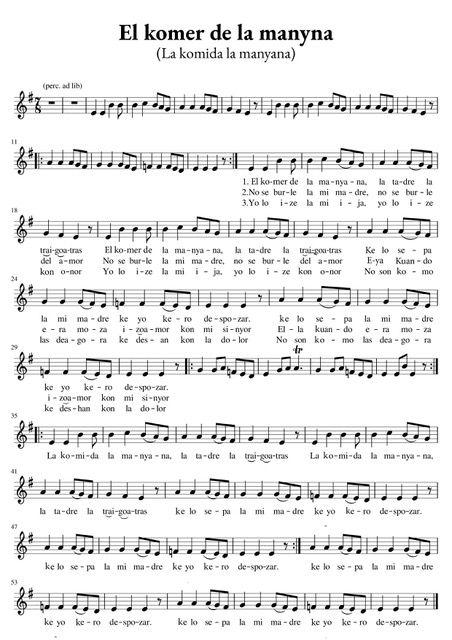
El komer de la manyana /ɛl koˈmeɾ de la maɲaˈna/ The morning meal
La tadre le traigo atras. /la ˈtaðɾe le ˈtɾaiɣo aˈtɾas/ I bring it back in the afternoon
Ke lo sepa la mi madre /ke lo ˈsepa la mi ˈmaðɾe/ Since my mother knows it
Ke yo kero d’espozar. /ke ʝo ˈkeɾo despoˈzaɾ/ That I want to get married
No se burle la mi madre /no se ˈbuɾle la mi ˈmaðɾe/ Don’t go crazy, Mom
No se burle del amor; /no se ˈbuɾle del aˈmoɾ/ Don’t go crazy over love
Eya kuando era moza /ˈeʝa ˈkwando ˈeɾa ˈmoza/ Back when she was just a girl
Izo amor kon mi sinyor. /ˈizo aˈmoɾ kon mi siɲˈʝoɾ/ She was in love with my master (my father).
Yo lo ize la mi ija /ʝo lo ˈize la mi ˈiʝa/ Yes, I was my daughter, and I was in love.
Yo lo ize kon l’amor; /ʝo lo ˈize kon laˈmoɾ/ It was real love
No son komo los de agora /no son ˈkomo los de aˈɣoɾa/ It’s not like the way things are nowadays,
Ke deshan kon la dolor. /ke ˈdeʃan kon la doˈloɾ/ where love often leaves you with pain.
Una ora en la ventana /ˈuna ˈoɾa en la benˈtana/ One moment by the window,
Otra ora en el balkon; /ˈotɾa ˈoɾa en el balˈkon/ the next on the balcony.
Ke lo sepa la mi madre /ke lo ˈsepa la mi ˈmaðɾe/ My mother knows it
Ke yo tengo mucho amor. /ke ʝo ˈteŋɡo ˈmutʃo aˈmoɾ/ that I am deeply in love.
Music Guide

 Bibliography
Research, analysis, translations and IPA transcriptions: Mariangela Chatzistamatiou Aural transcriptions and lead sheets: Nikos Panagiotides
Nehama, Joseph. Dictionnaire du Juedo-Espagnol. Madrid: Consejo superior de investigaciones cientificas,1977.
Disclaimer: The content on this website is protected by copyright. Use of the content is allowed for personal or educational purposes only with clear citation of the source. Republishing, modifying, or using the content for commercial purposes is prohibited without prior explicit permission.

