





Las demandas de Adanali
Description
This is a folk song that refers to a person named Adanali. It is quite common in folk music traditions for songs to revolve around a specific individual with whom the creator had some form of interaction or personal connection. Greek rebetiko music is full of such examples, as are the blues and early rock ’n’ roll in the Western musical tradition. The creator draws inspiration from someone in their environment and describes small, everyday moments which may not hold particular significance, but serve the purpose of the song. The lyrics do not provide enough information to clearly determine the historical context; however, it is evident that this is a popular (folk) text whose protagonists belong to the lower social strata. Adanali, dressed “à la turka,” meaning in an Ottoman style of clothing, buys shoes made of oilcloth. Later, the narrator asks Adanali for a series of small favors. The reference to Ottoman-style dress points to a period before the 20th century, when Western modes of dress began to prevail. Up until the early 20th century at the latest, the Sephardic Jews of Thessaloniki had adopted a style of dress similar to that of the Ottoman population. The text of the song is filled with words of Turkish origin,_ such as mushama, grush_, and paras.
Version 1
Las demandas de Adanali
Flora Molcho Archive Performed by her father, Isaak Molcho.
Lyrics
Adanali se merko kundurias /adaˈnali se meɾˈko kunduˈɾjas/ Adanali bought shoes
kundurias de mushama [1], vestido ala turka [2], mish! /kunduˈɾjas de muˈʃama vesˈtiðo a la ˈtuɾka miʃ/ polished shoes, dressed in the Turkish style, mish!
Adanali, vamos a la guerta, /adaˈnali ˈvamos a la ˈɡweɾta/ Adanali, let’s go to the garden
arankar lichugas kon uevo a la punta [3], mish! /aɾaŋˈkaɾ liˈtʃuɣas kon ˈwevo a la ˈpunta miʃ/ to pull out lettuces quickly, mish!
Adanali, dame un grushiko [4], /adaˈnali ˈdame un ɡɾuˈʃiko/ Adanali, give me some small change
si no tyenes tu paras [5], toma de Mushiko [6], mish! /si no ˈtjenes tu ˈpaɾas ˈtoma de muˈʃiko miʃ/ if you don’t have money, take some from Mushiko, mish!
Adanali, dame un sigaro, /adaˈnali ˈdame un siˈɣaɾo/ Adanali, give me a cigarette
si no tyenes tu tutun toma emprestado, mish! /si no ˈtjenes tu tuˈtun ˈtoma empɾesˈtaðo miʃ/ if you don’t have tobacco, borrow some, mish!
Adanali se muryo, la kantiga le kedo, mish! /adaˈnali se muˈɾjo la kanˈtiɣa le keˈðo miʃ/ Adanali died, and only the song remained, mish!
[1] mushama: from the Turkish word musamba, meaning fabric coated with wax or linseed oil. The phrase kundurias de mushama means polished (shiny) shoes. [2] in a Turkish style or aesthetic. [3] the phrase “kon el uevo a la punta” was used to describe someone leaving a task until the very last moment. It can also refer to someone rushing to relieve themselves at the last minute. Alternatively, it may be interpreted literally, meaning that they will make a lettuce-and-egg salad. There is also a possible interpretation that it refers to pulling up overgrown or seeding lettuces, though this is highly unlikely. [4] small change, a small amount of money, from the Turkish word kuruş (Greek: grosi). [5] coins or money, from the Turkish word para, a currency of the Ottoman Empire. [6] a diminutive of Moshe (Moses).
Version 2
Las demandas de Adanali
Flora Molho Archive Performed by women, possibly at a family gathering, though their identities have not been established.
Lyrics
Adanali se merko kundurias /adaˈnali se meɾˈko kunduˈɾjas/ Adanali bought shoes
kundurias de mushama a bailar la turka, mish! /kunduˈɾjas de muˈʃama a bajˈlaɾ la ˈtuɾka miʃ/ oilcloth shoes to dance a Turkish dance, mish!
Adanali se muryo la kantiga le kedo, mish! /adaˈnali se muˈɾjo la kanˈtiɣa le keˈðo miʃ/ Adanali died, and only the song remained, mish!
Adanali vamos a la guerta, /adaˈnali ˈvamos a la ˈɡweɾta/ Adanali, let’s go to the garden
arankar una lichuga kon uevo a la punta, mish! /aɾaŋˈkaɾ ˈuna liˈtʃuɣa kon ˈwevo a la ˈpunta miʃ/ to pull up lettuces in a rush, mish!
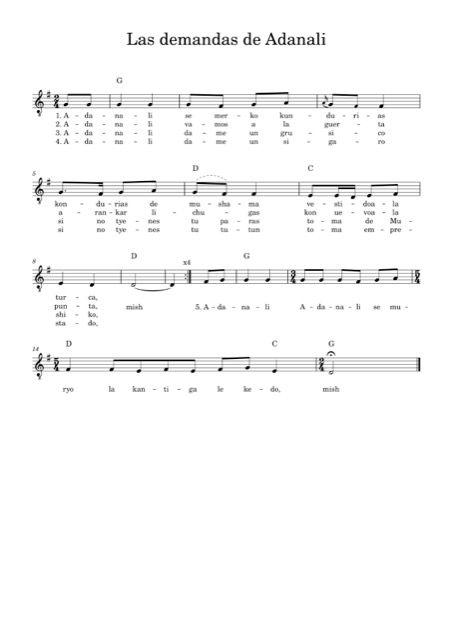
Music Guide

 Bibliography
Nehama, Joseph. Dictionnaire du Judéo-Espagnol. Consejo superior de investigaciones cientificas. Madrid, 1977.
Research, analysis, translations and IPA transcriptions: Mariangela Chatzistamatiou Aural transcriptions and lead sheets: Nikos Panagiotides
Disclaimer: The content on this website is protected by copyright. Use of the content is allowed for personal or educational purposes only with clear citation of the source. Republishing, modifying, or using the content for commercial purposes is prohibited without prior explicit permission.

