




El ermano infame
Description
This is one of the lesser-known songs of the Sephardic tradition, dealing with the theme of incestuous desire, featuring a young girl who resists the forbidden wishes of her brother. In the first stanza, the heroine is introduced as a young, beautiful girl (“blanka i ermoza komo yasemi” [fair and beautiful as jasmine]) who is devoted to her work and supports herself (“kuziendo robas para la djente” [sewing clothes for the people]). This image reinforces the idea of the girl’s innocence and purity, as her daily life appears simple and moral. The use of “yasemi” to describe her beauty further emphasizes the symbolism of purity, as jasmine is often associated with cleanliness and delicacy.
In the second stanza, the drama emerges when her brother expresses his illicit desires. The phrase “tu ermozura me kita loko” [your beauty drives me mad] reveals that he is so consumed by passion that he cannot think rationally. His desire to become her husband is clearly incestuous and sinful, coming into conflict with social and religious norms. His passion for his sister is portrayed as both irresistible and immoral.
In the third stanza, the sister responds, calling him “kruelo” (cruel), highlighting how immoral she considers his proposal. Rather than yielding to her brother’s desires, she prefers death (“mil vezes mas prefiero mi muerte”) over sullying her family’s honor and her own morality. The phrase “ma de tu sangre manchar mi onor no” [but with your blood I will not stain my honor] emphasizes the intensity of her reaction, as honor and purity were highly valued in the traditional society depicted in the poem. The heroine’s “fair” beauty symbolizes her purity, while her brother’s desire represents a threat to it.
This song is found both in the traditions of Thessaloniki and Rhodes, as well as in the traditions of Turkey and Bulgaria, according to the archives of Moshe Saul.
Version 1
El ermano infame
Archive of Nikos Tzannis-Ginnerup. Property of Jewish Museum of Thessaloniki. Unknown performer.
Lyrics
Avia de ser una muchacha, aˈvi.a de ˈseɾ una muˈtʃatʃa There once was a young girl,
blanka i ermoza komo yasemi. blaŋka i eɾˈmo.sa ˈko.mo ʝa.sɪˈmi fair and lovely as jasmine.
Eya solika se mantenia, ˈe.ja soˈli.ka se man.teˈni.a She worked all by herself,
kuziendo robas para la djente. kuˈzjendo ˈro.bas ˈpa.ɾa la ˈdʒen.te sewing clothes for everyone.
Un dia l’ ermaniko le dezia: un ˈdi.a l’ eɾ.maˈni.ko le deˈzi.a One day her little brother said,
“Ermana mia, luzia de mi korason, eɾˈma.na ˈmi.a luˈzi.a de mi koɾaˈson “My sister, light of my heart,
tu ermozura me kita loko, tu eɾ.moˈzu.ɾa me ˈki.ta ˈlo.ko your beauty drives me mad
marido tuyo kiero ser yo.” maˈɾi.ðo ˈtu.jo ˈkje.ɾo seɾ ˈʝo I want to be your husband.”
La ermana le respondia: la eɾˈma.na le res.ponˈdi.a The sister answered him,
“Ermano mio, kruelo de mi korason, eɾˈma.no ˈmi.o ˈkɾwe.lo de mi koɾaˈson “My brother, cruel one, who makes my heart bleed,
mil vezes mas prefiero mi muerte, mil ˈve.zes mas pɾeˈfje.ɾo mi ˈmweɾ.te a thousand times I’d rather die
ma de tu sangre manchar mi onor no.” ma de tu ˈsaŋ.gɾe manˈtʃaɾ mi oˈnoɾ ˈno than stain my honor with your blood.”
Version 2
El ermano infame
Moshe Saul Archive-El trezoro de kanters de Sefarad. Maale Adumim Institute. Catalogue Number: #1531 https://folkmasa.org/avshir/shirp.php?mishtane=1531 Performed by Violeta Fints
Lyrics
Avia una djoven, alta i blonda komo el kandil. aˈvi.a ˈu.na dʒoˈven ˈal.ta i ˈblon.da ˈko.mo el kanˈdil There was a young girl, tall and fair like a lantern.
Eya solika se mantenia, koziendo ropas para Madrid. ˈe.ja soˈli.ka se man.teˈni.a koˈzjen.do ˈro.pas ˈpa.ɾa maˈdɾið She lived on her own, sewing clothes for Madrid.
Antes tres anyos, la povre ninya, padre i madre se le morian. ˈan.tes ˈtɾes ˈa.njos la ˈpo.vɾe ˈni.nja ˈpa.ðɾe i ˈma.ðɾe se le moˈɾi.an Three years earlier, the poor girl lost her father and her mother.
Solo le kedava un povre ermano, ke d'eya se enamoro. ˈso.lo le keˈða.va un ˈpo.vɾe eɾˈma.no ke ˈde.e.ja se e.na.moˈɾo Only one poor brother remained to her, and he fell in love with her.
Un dia le dize su ermano: “Ermana mia de me korason, un ˈdi.a le ˈdi.ze su eɾˈma.no eɾˈma.na ˈmi.a de me koɾaˈson One day her brother said to her: “My sister, flame of my heart,
tu ermozura me kita loko, ke tu marido kero ser yo.” tu eɾ.moˈzu.ɾa me ˈki.ta ˈlo.ko ke tu maˈɾi.ðo ˈke.ɾo seɾ ˈʝo your beauty drives me mad, I want to become your husband.”
“Ermano mio” le rsponde su ermana. eɾˈma.no ˈmi.o le resˈpon.de su eɾˈma.na “My brother,” his sister replied.
“Ermano, flama de mi korason. eɾˈma.no ˈfla.ma de mi koɾaˈson “My brother, flame of my heart,
Mas prefero murir sien vezes, ke de tu sangre manchar mi onor.” mas pɾeˈfe.ɾo muˈɾiɾ ˈsjen ˈve.zes ke de tu ˈsaŋ.ɡɾe manˈtʃaɾ mi oˈnoɾ I would rather die a hundred times than stain my honor with your blood.”
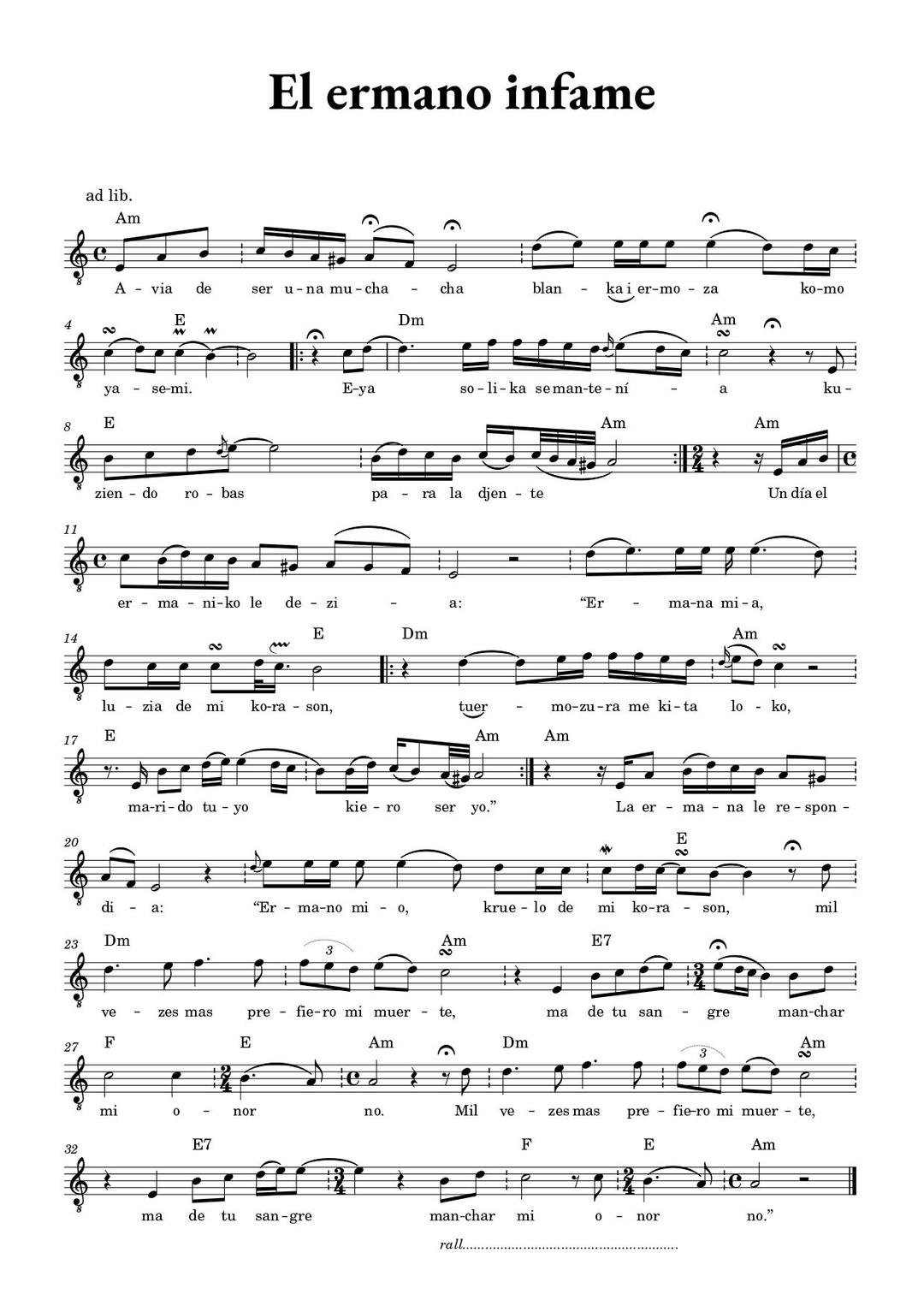
Music Guide

 Bibliography
El Trezoro de Kantes de Sefarad. El Instituto Maale Adumim para la documentación de la lengua judeo-española y su cultura, folkmasa.org.
Nehama, Joseph. Dictionnaire du Judéo-Espagnol. Madrid: Consejo superior de investigaciones cientificas, 1977.
Research, analysis and translations: Mariangela Chatzistamatiou Aural Transcriptions and Lead Sheets: Nikos Panagiotides
Disclaimer: The content on this website is protected by copyright. Use of the content is allowed for personal or educational purposes only with clear citation of the source. Republishing, modifying, or using the content for commercial purposes is prohibited without prior explicit permission.

